
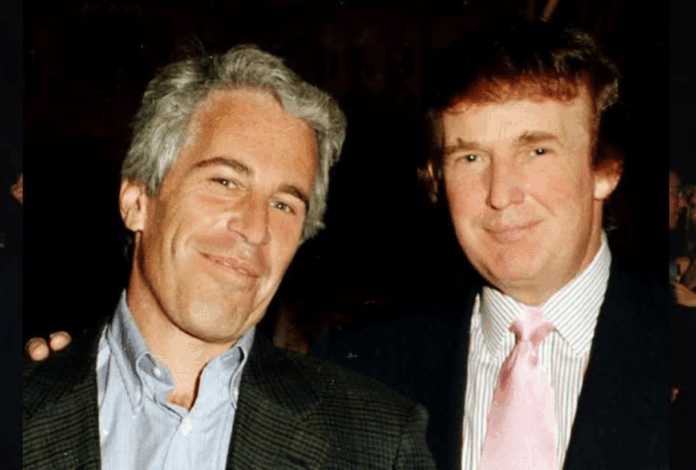
President Donald Trump has signed legislation ordering the release of government documents related to convicted sex offender Jeffrey Epstein.
The move comes after months of public pressure and represents a reversal from the Trump administration’s initial resistance to releasing the files. The legislation, called the Epstein Files Transparency Act, passed Congress with overwhelming bipartisan support—427-1 in the House and unanimous consent in the Senate.
The new law directs Attorney General Pam Bondi to publicly release all unclassified documents related to the Epstein investigation and prosecution within 30 days. The files must be made available in a searchable, downloadable online format.
However, the law includes essential exceptions. The Justice Department may withhold:
- Victims’ personal information
- Child sexual abuse materials
- Information that could jeopardise active federal investigations
President Trump initially opposed releasing the files, calling the controversy a “hoax” and attacking reporters who asked about it. He reversed course after it became clear the bill would pass Congress with or without his support.
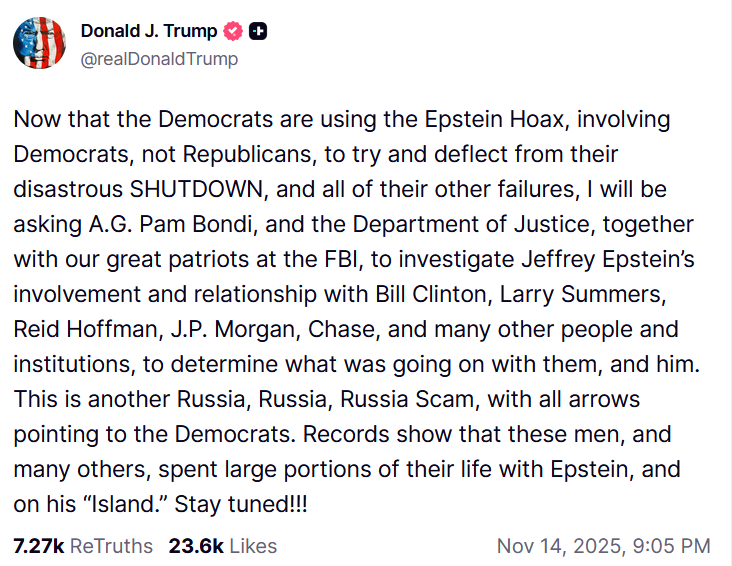
In his Truth Social announcement, Trump called the controversy an “Epstein Hoax” and characterised it as a Democratic attempt to deflect from what he called their “disastrous SHUTDOWN.” He announced that he would direct Attorney General Pam Bondi and the Department of Justice to investigate Jeffrey Epstein’s relationships with several prominent figures, including:
- Former President Bill Clinton
- Former Treasury Secretary Lawrence Summers
- Tech investor Reid Hoffman
- Financial institution J.P. Morgan Chase
Trump compared the situation to what he called the “Russia, Russia, Russia Scam,” stating that “all arrows are pointing to the Democrats.” He claimed that records show these individuals “spent large portions of their life with Epstein, and on his ‘Island.’”
Trump himself was friends with Epstein until the early 2000s, when the two had a falling out. Emails and documents have shown connections between the two men, though Trump has repeatedly denied knowledge of Epstein’s crimes and has not been charged with any wrongdoing related to Epstein.
Jeffrey Epstein died by suicide in a Manhattan jail cell in 2019 while awaiting trial on federal sex trafficking charges.
Despite the bill’s passage, questions remain about whether all documents will actually be released. Attorney General Bondi recently launched new investigations into several individuals whose names appeared in Epstein’s communications—investigations that could potentially allow the Justice Department to withhold documents as part of “active federal investigations.”
Critics, including some Republican lawmakers who supported the bill, have warned that the administration may use these investigations to limit what gets released.

